

Why Do I Shut Down During Conflict?
Understanding the Nervous System Shutdown Response
By Tanya Marie. 10 minute read.
For years, I thought something was wrong with me, and I felt so much shame and guilt.
When conflict hit - especially unexpected conflict - I would go flat.
Not calm. Not choosing to be silent. Flat, like someone had pulled a plug.
My face would go still. Words would disappear, in fact it was an enormous effort to speak at all.
It was almost as though some invisible force was wiring my jaw shut.
And the more someone demanded I speak, the worse it got. I kind of disappeared inside myself, and I had no idea how to return.
And I couldn't explain any of it. What made it worse was what other people saw.
They saw someone who looked checked out. Cold. Maybe even manipulative. You know, the kind of silence some use to punish.
But inside, that wasn't what was happening at all.
I wasn't deciding not to speak.
I couldn't seem to speak.
It took me decades to discover that there were nervous system concepts that could help explain what I had experienced: the freeze and shutdown responses, including what is sometimes described in polyvagal theory as a dorsal vagal state.
Learning that changed the way I understood myself - and the many interactions and relationships I had blamed myself for over the years.
Why Do I Shut Down During Conflict?
The short answer: when some people experience conflict or emotional overwhelm, their nervous system can respond automatically to a perceived threat.
Instead of fighting or escaping, the response may be to freeze or shut down.
That can make it difficult to speak, think clearly, express emotion or connect with the person in front of you.
It can look like silence from the outside. On the inside, it can feel completely different.
For me, it felt as though my entire system had simply switched off.
I Lost a Relationship Without Understanding Why
I lost a once-close family relationship over this.
They arrived with their partner for a long awaited visit, and unexpectedly something was said that triggered me into shutdown.
For the rest of the week I was flat. Emotionless. I couldn't find words. I couldn't access warmth, or be me.
I knew it was happening. I knew it wasn't good. But I couldn't explain why, because I didn't understand it myself.
Even though I was aware of what was happening, I still couldn't seem to stop it.
I had no language for what was happening in my body. Neither did they.
So they filled in the blank with their own interpretation.
And the relationship has never recovered. In fact they no longer speak to me.
That's one of the hardest things about shutting down during conflict: other people can only interpret what they can see.
They can't feel what's happening inside your body.
Silence can therefore be interpreted as rejection, punishment, indifference or passive aggression when the person experiencing it may desperately wish they could respond differently.

What Shutdown Felt Like in My Body
For me, shutdown wasn't just something happening "in my head." I felt it physically.
It started with a sensation like being hit in the chest, followed by a coldness that seemed to spread throughout my body.
Once it was there, I couldn't think my way out of it.
I couldn't "snap out of it."
I wasn't choosing silence.
Silence was what my body was doing to me.
Eventually, learning about the autonomic nervous system gave me a completely different way of looking at what had been happening.
What Does the Nervous System Have to Do With Shutting Down?
The autonomic nervous system helps regulate many processes that happen without us consciously directing them - things such as heart rate, breathing and digestion.
It is also involved in our responses to perceived danger and safety.
Most of us have heard of fight or flight.
When something feels threatening, you might notice your heart beating faster, your muscles tightening or an overwhelming urge to argue, defend yourself or leave.
But fight or flight aren't the only responses associated with threat.
Humans can also experience freezing, immobility or shutdown-like responses.
One framework that has become influential in trauma-informed and therapeutic communities is polyvagal theory, developed by neuroscientist Dr. Stephen Porges.
The theory proposes a way of understanding autonomic states associated with social connection, mobilisation such as fight or flight, and immobilisation or shutdown.
Polyvagal theory has also been the subject of scientific debate, particularly around some of its proposed evolutionary and physiological mechanisms.
I use it here as a framework that helped me understand my own experience, rather than as a diagnosis or the only scientific explanation for shutdown.
For me, it provided something enormously valuable:
a language for an experience I had never been able to explain.
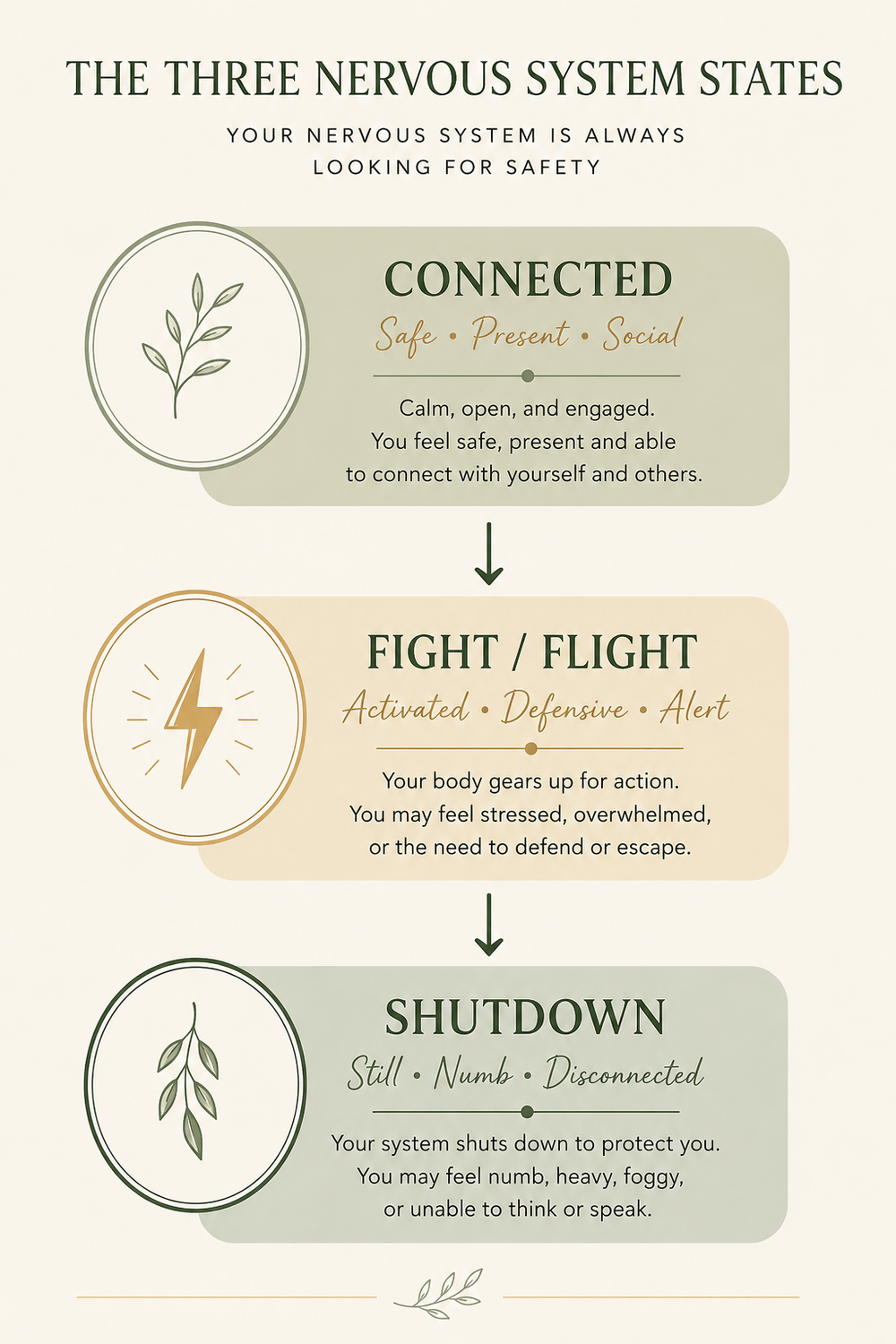
The Three States Described in Polyvagal Theory
In simplified terms, polyvagal theory describes three broad nervous-system states.
Ventral vagal: safe and connected
This is associated with feeling relatively safe, present and socially connected.
You may find it easier to think clearly, speak naturally, read another person's expressions and respond flexibly.
Your face and voice are expressive.
You feel like you.
Sympathetic: fight or flight
This is the stress response most of us recognise.
Your heart may race. Your muscles tense. Your attention narrows.
During conflict, this might look like raising your voice, becoming defensive, pacing, arguing or wanting to escape.
It's uncomfortable, but it's visible.
Other people can usually recognise that you're upset.
Shutdown or immobilisation
Sometimes overwhelming situations produce a very different response.
Instead of becoming louder or more active, you become quieter.
You may feel numb, distant, heavy, foggy or strangely disconnected.
Your face may become less expressive.
Thinking and finding words can become difficult.
Within polyvagal theory, a form of this immobilisation is commonly described as dorsal vagal shutdown.
And when I first read descriptions of it, something clicked. Oh my gosh...that is exactly what I experience.
In fact, reading it made me cry.
A wave of grief rose up in me as I thought about how I had lost her... and about all the other times in my life I had shut down, and been misunderstood because of it.
Times when people thought I was cold, difficult, punishing or uncaring, when inside I was simply gone - unable to explain what was happening, even to myself.
I grieved for the relationships, the misunderstandings, and all the years I had blamed myself for an experience I had never even had words for.
I knew I wasn't sulking or trying to punish anyone. But until then, I simply hadn't understood what was happening or why.
I only knew that once I shut down, it could take days - often weeks - before I felt fully like myself again.
"I wasn't choosing silence. Silence was what my body was doing to me.”
Shutdown Isn't Necessarily Passive Aggression
This is what I wish I had understood years ago - and what I wish the people around me had understood.
Going silent during conflict doesn't automatically mean someone is sulking, punishing another person or deliberately withholding communication.
Sometimes there is an involuntary stress response happening underneath the behaviour.
That doesn't mean every instance of silence is a nervous system shutdown.
People can deliberately withdraw or use silence in unhealthy ways.
But outwardly similar behaviour can have very different causes.
That's why understanding what is happening underneath it matters.
For some people, conflict may become particularly difficult if previous experiences have taught them that arguing back, escaping or expressing themselves isn't safe or doesn't help.
Over time, certain situations may trigger an automatic response long before the thinking mind has had time to make sense of what's happening.
Why Can't I Talk When I'm Overwhelmed?
This was one of the hardest things for me to explain.
I could know cognitively that I should speak.
I could want to speak.
I could see that the other person was becoming more frustrated because I wasn't responding.
And still the words wouldn't come.
My mind felt blank.
My body felt heavy and cold.
The more pressure I felt to explain myself, the harder explaining myself became.
That's an important distinction.
If someone is struggling to think and communicate because they are overwhelmed, repeatedly demanding an explanation may add even more pressure to a system that is already struggling.

Why “Just Snap Out of It” Doesn't Help
You cannot always reason yourself immediately out of an automatic stress response.
That doesn't mean you're powerless or that these patterns can never change.
It means that in the moment, adding more pressure may not be the most useful first step.
For me, shutdown could last far longer than the conflict itself.
Sometimes I felt flat and distant for days, even weeks.
I didn't understand why.
I just knew that I couldn't easily access the part of myself that normally connected with other people.
Relationships suffered.
Then I blamed myself for not being able to fix it.
And that shame created another layer of distress on top of what I was already experiencing.
Learning to recognise the pattern changed that.
Instead of immediately thinking, "What is wrong with me?" I could begin asking:
"What is happening in me right now?"
That is a very different question.
What Helps When You Shut Down During Conflict?
I want to be clear that this isn't a clinical guide.
I'm not a therapist or medical professional. I'm sharing my own experience and some of what I have learned while trying to understand it.
For me, pressure did not help.
Being pushed to talk when I couldn't find words didn't help.
Being interpreted as deliberately difficult didn't help.
Complex questions didn't help.
And blaming myself certainly didn't help.
What I found more useful was giving my body time and reducing the sense of pressure.
Simple sensory experiences could feel more accessible than trying to reason my way back to feeling normal.
Sound.
Warmth.
Rhythm.
Humming.
Singing.
Gentle, predictable touch.
A calm voice.
Space to return without being forced to perform or explain.
Different people will find different approaches helpful, and persistent or distressing symptoms are worth discussing with an appropriately qualified professional.
But one of the biggest changes for me was simply realising that my body was a big part of the conversation.
How This Changed the Work I Do Today
Understanding this sent me much further into exploring the relationship between sound, touch and how we feel.
I became fascinated by something incredibly simple:
Sometimes words aren't the easiest way in.
Music gives us rhythm, sound and repetition.
Humming and singing engage the voice and breath.
Gentle touch gives the body another form of sensory input.
My experience with overwhelm and shutdown eventually led me to create The Sanctuary Collection™: Foundation.
Foundation is designed to be exactly that - the foundation. It combines original songs with gentle Sanctuary Touch™ in a simple daily practice created to help you build greater resilience to everyday stress.
The goal isn't to be calm all the time.
It's to become better able to meet life's inevitable stressors, move through them, and find your way back to yourself.
And because the last thing an overwhelmed person needs is another complicated wellbeing routine, it's designed to be something you can simply press play and do.
Because stress itself isn't the enemy.
Life will still happen.
There will still be difficult conversations, unexpected problems, busy days and moments that knock you off balance.
For me, the real goal became something different: not avoiding those responses altogether, but becoming more resilient - less easily overwhelmed by them and better able to recover afterwards.
I don't believe we need to spend our lives analysing ourselves.
Sometimes we need something simple enough to actually use.

If You Recognise Yourself in This
If you've ever wondered:
Why do I shut down during conflict?
Why do I go silent during arguments?
Why can't I find words when I'm overwhelmed?
I hope my experience gives you another possibility to consider.
Your response may have an explanation beyond simply being "bad at conflict."
Learning about freeze and shutdown responses gave me a framework for understanding something I had spent years judging myself for.
It also helped me recognise that understanding the pattern doesn't mean excusing everything that happens around it.
Communication still matters.
Relationships still matter.
Learning how to reconnect still matters.
But it's much easier to work with something once you understand what may be happening.
I wish I had known that years ago.
I wish some of the people I lost along the way had known it too.
But I know it now.
And perhaps, if you recognised yourself somewhere in this article, you have a new place to begin too.
Key Takeaway
Going silent during conflict isn't always a deliberate refusal to communicate.
For some people, overwhelming situations can be accompanied by automatic freeze, immobility or shutdown-like responses that make thinking and speaking difficult.
Polyvagal theory offers one framework for understanding these experiences, although aspects of the theory remain scientifically debated.
Frequently Asked Questions
Why do I go silent during arguments?
There can be many reasons. For some people, intense conflict or overwhelm can trigger an automatic freeze or shutdown response, making thinking, speaking or connecting more difficult in the moment. If this happens frequently or causes significant distress, a qualified professional can help you explore what may be contributing to it.
Is shutting down during conflict the same as giving someone the silent treatment?
Not necessarily. Deliberately refusing communication in order to punish or control someone is different from experiencing an involuntary stress response that makes communication difficult. From the outside they can sometimes look similar, which is why misunderstanding can occur.
What is dorsal vagal shutdown?
“Dorsal vagal shutdown” is a term commonly used within polyvagal theory to describe an immobilised or shutdown state. People may describe feeling numb, disconnected, heavy or unable to engage normally. Polyvagal theory is widely used as a therapeutic framework, although some of its underlying scientific claims remain debated.
Can nervous system responses change?
People can learn to recognise their patterns and develop ways of responding differently over time. What helps varies from person to person, and professional support may be appropriate when shutdown, trauma symptoms or dissociation are persistent or significantly affect daily life.
A Simple Next Step
If you'd like to experience the approach I've created for yourself, you don't need to begin with the full Foundation program.
The 7-Day Sanctuary Experience was created to feel different - original music, gentle Sanctuary Touch™ and a simple daily practice designed to help you feel less overwhelmed, more emotionally steady, and a little more like yourself again.
If you recognise this sense of having too much going on even outside conflict, you may also relate to Why Do I Feel Overwhelmed When Nothing Is Actually Wrong?
Important Note
I am not a therapist, counsellor or medical professional. This article describes my personal experience and my understanding of nervous system concepts. It is for general educational purposes and isn't a substitute for professional medical or mental health advice.
If you're experiencing persistent shutdown, dissociation or other symptoms that are distressing or interfering with daily life, consider seeking support from an appropriately qualified health professional.
Sources & Further Reading
Stephen W. Porges, The Polyvagal Theory: New Insights into Adaptive Reactions of the Autonomic Nervous System - Cleveland Clinic Journal of Medicine.
Read at PubMed CentralStephen W. Porges, Polyvagal Theory: Current Status, Clinical Applications, and Future Directions (2025).
Read at PubMed CentralPaul Grossman et al., Why The Polyvagal Theory Is Untenable: An International Expert Evaluation (2026).
Read at PubMed CentralStephen W. Porges, When A Critique Becomes Untenable: A Scholarly Response (2026).
Read at PubMed Central
Further reading for a general audience: Deb Dana, Anchored: How to Befriend Your Nervous System Using Polyvagal Theory.

Tanya Marie is the creator of The Sanctuary Collection™, a collection of multi-sensory, music-based wellbeing experiences combining original songs with gentle Sanctuary Touch™
Her work grew from her own decades-long experience of chronic exhaustion and overwhelm, and from searching for something that could genuinely help without becoming another complicated routine to keep up with.
When nothing quite suited, or worked, she began exploring a different approach: using music she would naturally want to return to, combined with simple gentle touch and practices that could fit into everyday life.
What began as something she created for herself eventually became The Sanctuary Collection™ - designed to help women feel better, build greater resilience to everyday stress, and feel more like themselves again without adding more pressure.
The Sanctuary Collection™
Multi-sensory programs combining original music, gentle touch and simple daily practices to help you build greater resilience, shift long-held patterns and create meaningful change - one song at a time.