

Why Am I Exhausted All the Time? What 30 Years of Chronic Fatigue Taught Me
Tanya Marie. 11 min read.
Why Am I Exhausted All the Time? What 30 Years of Chronic Fatigue Taught Me
For more than 30 years, exhaustion shaped my life. Not ordinary I've had a long day tiredness.
The kind of exhaustion that changes what you can do, where you can go and how much of yourself you have left to give to the people you love.
I spent decades looking for answers.
And a great deal of my spare money trying things that I hoped might finally be the thing that would help.
Because when you're exhausted all the time, you don't just want more energy.
You want your life back.
I wanted to be able to do things without constantly calculating whether I had enough energy.
I wanted to make plans without wondering whether I'd be able to follow through.
And perhaps most painfully, I wanted to be the mother I felt I could have been if I hadn't been so tired.
For years, I kept thinking there had to be something I hadn't found yet.
Some missing answer.
Some underlying problem.
Something I could fix if I just searched hard enough.
So I kept searching.
When Tiredness Starts Taking Your Life Away
There is a difference between being tired and having exhaustion begin to dictate your life.
When you're tired, you might cancel something because you've had a difficult week.
When exhaustion becomes part of everyday life, you start organising your existence around it.
Can I manage that today?
If I do this, will I have enough energy for that?
Maybe I'll feel better tomorrow.
Tomorrow becomes very important.
Because tomorrow is when you imagine you might finally have enough energy to catch up.
Tomorrow you'll make the phone call.
Tomorrow you'll sort the cupboard.
Tomorrow you'll go somewhere.
Tomorrow you'll begin the thing you've been wanting to do.
Tomorrow you'll feel more like yourself.
And then tomorrow arrives.
And you're still exhausted.
I lived with versions of that cycle for decades.
The Exhaustion Affected More Than My Energy
One of the hardest things about long-term exhaustion is that it doesn't stay neatly contained in your body.
It reaches into your relationships.
Your confidence.
Your finances.
Your plans.
Your parenting.
Your sense of who you are.
There were so many things I wanted to do with my children that I simply didn't have the energy for.
That's difficult to write even now.
Because when you're a mother, you don't think:
I'm too exhausted, therefore I'll simply lower my expectations.
You think about the mother you want to be.
Then you see the gap between that woman and what you can actually manage that day.
And you can feel enormous guilt about it.
I wasn't choosing not to participate in my life.
So often, I simply didn't have enough in the tank.
When People Don't Believe How Exhausted You Are
Back in the 1990s, one of the hardest parts wasn't only the exhaustion itself.
It was not being believed.
I knew I wasn't lazy.
I knew I wasn't imagining it.
I knew how desperately I wanted to have the energy to live my life, do things with my children and simply function normally.
But when there was no obvious explanation for why I was so exhausted, I was sometimes treated as though I was a hypochondriac or just needed to try harder.
For a long time, it was mainly naturopaths and other alternative practitioners who seemed to take what I was experiencing seriously.
Over the years I was given different explanations.
At one point I was told I had chronic fatigue.
Years later, during a severe collapse, I was told I had “adrenal exhaustion.”
The labels changed.
The exhaustion didn't.
And there is something particularly painful about living with symptoms that other people can't see.
If you have a broken leg, nobody expects you to run.
But profound exhaustion can be invisible.
People see you lying down.
They don't necessarily see how much you wanted to be able to get up.
They see what you aren't doing.
They don't see the enormous effort it may have taken to do the few things you managed that day.
So you aren't only dealing with the exhaustion.
You can also be dealing with judgement, disbelief and the shame other people attach to something you never chose.
Not only suffering, but being shamed for suffering.
For me, that was part of the experience too.
I Spent Years Searching for the Reason
When something has been wrong for a long time, you naturally look for an explanation.
I did.
For years.
I investigated different possibilities.
I tried products.
I tried approaches.
I spent money I really couldn't afford to waste because every new possibility carried the same hope:
Maybe this will finally be it.
Some things did nothing.
Some helped a little.
A few helped enough that I could function better for a while.
But I never felt as though I had really solved the underlying problem.
And when something did help, it could be expensive to maintain or require a great deal of it.
I became very familiar with surviving rather than thriving.
You function.
You get through what absolutely has to be done.
And from the outside, that can sometimes look deceptively normal.
But you know how much effort is going into appearing functional.
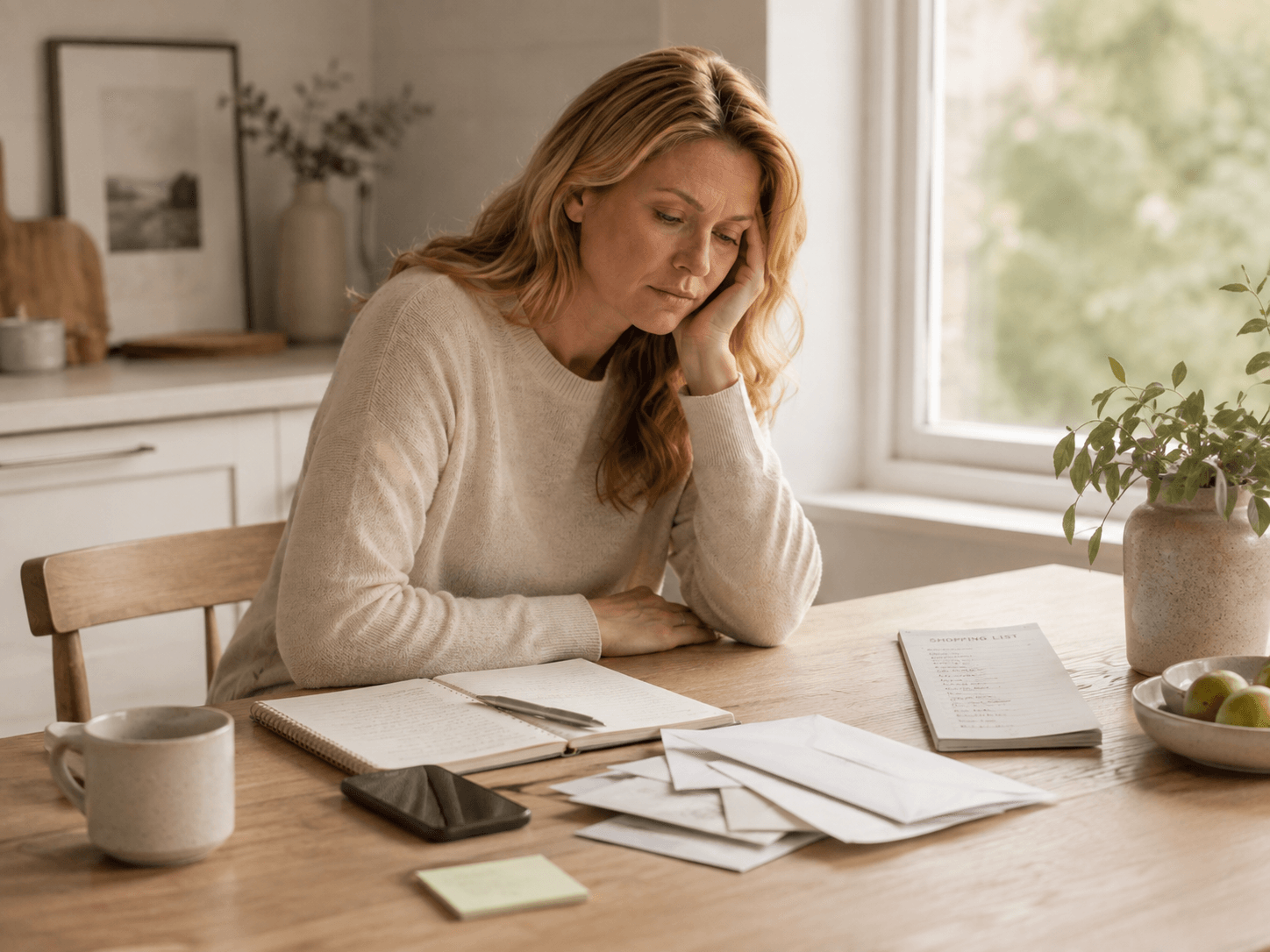
Then Everything Fell Apart Again
After a prolonged period of major stress, I had a huge relapse around 2015.
For months, I spent much of my day in bed.
I'd get up.
Shower.
Get dressed.
And very often go back to bed.
I simply couldn't stay up for very long.
This wasn't an inconvenient bout of tiredness.
I couldn't work properly.
And when you can't work, exhaustion suddenly isn't only about your health.
It becomes about survival.
I knew I was at risk of losing my home.
I was terrified about what would happen if I couldn't find a way to function again.
And fear itself becomes another thing you're carrying.
You're exhausted.
You're frightened because you're exhausted.
You're under more stress because you can't work.
And you're desperately trying to find the energy to solve the problem that is stopping you from solving the problem.
I Found Things That Helped Me Get Through
Eventually I found something that seemed to help.
It wasn't a miraculous transformation.
I needed quite a lot of it, and it was expensive.
But it gave me enough improvement to keep going.
And sometimes enough to keep going is incredibly valuable when the alternative feels like not functioning at all.
For roughly the next eight years, that was largely how life felt.
Better than the worst period.
Able to do more.
But still struggling.
Still managing energy.
Still trying to find answers.
Still not really thriving.
Then I Collapsed Again
Years later, after moving overseas, things became dramatically worse again.
In hindsight, I see it as another major collapse.
This time there was something particularly frightening about it.
My thinking was affected much more severely.
The brain fog was extraordinary.
Previously, even when my body wasn't cooperating, I could still think reasonably clearly.
This time I felt barely functional.
Getting out of bed became difficult again.
Thinking became difficult.
Doing ordinary everyday things became difficult.
A family member had to take over things like shopping and cooking because I simply couldn't manage them.
And I was frightened.
Because there was one question running underneath everything:
What do I do now?
I had already spent decades searching.
I had tried so many things.
What exactly was left to try?
“Maybe Tomorrow I'll Have the Energy”
After a year or so, I found a couple of products that helped enough to improve my functioning somewhat.
But I was still enormously fatigued.
Most days involved a lot of lying down.
And that familiar thought returned:
Maybe tomorrow
Maybe tomorrow I'll have the energy to do what needs doing.
Maybe tomorrow I'll finally do what I want to do.
Maybe tomorrow will be different.
There is something deeply frustrating about having ideas, interests and things you want from life while feeling as though your body has put the brakes on all of them.
You can know perfectly well what you would do if you had the energy.
The problem is getting access to enough of yourself to actually do it.

Eventually, I Began Asking a Different Question
For decades, I had largely approached the problem by asking:
What is wrong with me that I need to find and fix?
I wondered about infections.
I wondered about physical causes.
I searched for things that might need treating.
And to be very clear, persistent or severe fatigue can have many medical causes and deserves proper investigation.
Fatigue can be associated with sleep problems, anaemia, thyroid conditions, medications, hormonal changes, infections and many other physical and psychological conditions.
ME/CFS is also a distinct complex illness and should not be reduced to simply being “stressed.”
I am not suggesting that everyone who experiences chronic exhaustion has the same explanation I eventually began considering for myself.
But after all those years, I started looking somewhere I hadn't really looked before.
I began learning about stress responses, the nervous system and the way our bodies respond to perceived danger.
The Nervous System Gave Me a Different Lens
Our nervous system is involved in the way the body responds to stress and perceived threat.
That is a normal part of being human.
But for me, learning about this gave me a completely different way of looking at what I had experienced.
Instead of seeing my body purely as something broken that I had failed to fix, I began wondering whether years of prolonged stress and feeling under threat might be part of the picture for me.
I started thinking less in terms of:
What hidden thing do I need to defeat?
and more in terms of:
What might help my body experience more safety and ease?
That question changed the direction I took.
I am not saying I suddenly discovered one simple medical explanation for 30 years of fatigue.
I didn't.
What I discovered was a new avenue to explore.
And for me, that avenue eventually made a meaningful difference.
The Problem Was That Many Programs Still Felt Like Too Much
Once I started learning more about stress responses and the nervous system, naturally I looked for programs that might help.
And some of them were good.
I wanted to do them.
But I ran into the same problem I'd encountered before.
They were too much for me.
When you're barely functioning, something that requires concentration, lessons, exercises, journalling and daily commitment can feel enormous.
I didn't lack motivation.
I desperately wanted to get better.
I simply didn't have much capacity.
The very thing that was supposed to help required resources I didn't have.
That experience eventually became an important part of the way I think about wellbeing now:
It doesn't matter how good a practice is if you're too overwhelmed or exhausted to actually use it.
Then I Remembered Touch
Over the years, I had experienced different approaches involving gentle touch, including techniques such as EFT/tapping and somatic touch.
One thing I remembered clearly was that the physical touch methods had felt helpful to me.
Some of these approaches paired touch with words, intentions or attention to a particular issue.
And eventually I thought:
I can experiment with this myself.
But I didn't particularly want another exercise where I stood there repeating phrases because I was supposed to.
I wanted something I would actually enjoy.
And then the obvious answer occurred to me.
Songs.
I love music.
I love songs.
If I like a song, I will willingly play it again and again.
Nobody has to remind me to complete my prescribed music-listening homework.
So I began wondering:
What if I could combine the words I wanted to hear with music I actually wanted to listen to - and pair that with gentle touch?
So I started experimenting.
Something Finally Felt Different
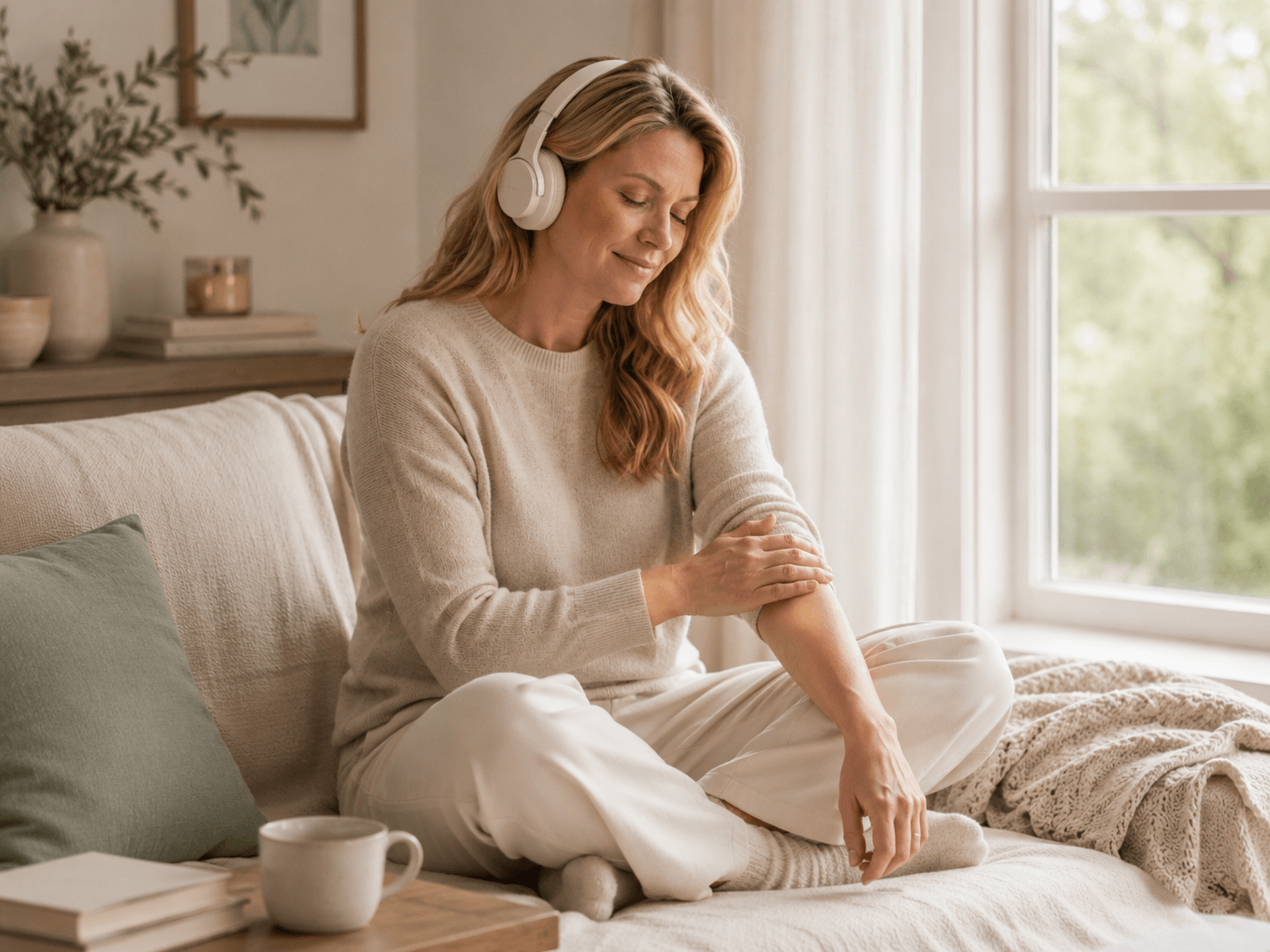
The songs and touch seemed to help me.
I want to be careful with that sentence.
I am describing my experience.
I am not claiming that music and touch cure chronic fatigue, ME/CFS or any other medical condition.
And I would never suggest that someone ignore persistent symptoms because they have decided their nervous system must be responsible.
But something changed for me.
As I continued using the music, the words and the gentle touch, I began noticing improvements.
My energy improved.
My ability to function improved.
And another thing began changing too.
I had reached a point where I was afraid to go out.
Yes, the irony - the person who had packed up and moved across the world now struggled to leave the house.
My world had become much smaller.
Gradually, that began to shift as well.
Not overnight.
Not as one dramatic miracle.
But enough for me to know that I wanted to keep going.
That Experiment Eventually Became The Sanctuary Collection
At first, I was simply trying to create something for myself.
Something simple enough that I could actually do it.
Something that didn't feel like another program I was failing to complete.
Something enjoyable.
Something repeatable.
Something that could fit around the energy and life I actually had.
Over time, the idea grew.
The songs developed.
The touch evolved into Sanctuary Touch™.
And what began as my own experiment eventually became The Sanctuary Collection.
That history is why simplicity matters so much to me.
It isn't simply a marketing angle.
I remember what it was like to be given something else that might help and think:
I can't. I genuinely cannot add another thing.
I wanted to create something for the woman who feels like that.
I Don't Believe Every Case of Exhaustion Has One Answer
After spending decades searching for the answer, perhaps one of the biggest things I've learnt is to be wary of anyone who says there is only one.
Fatigue is a symptom.
It can have many causes.
Sometimes several things may be contributing at the same time.
And if you're experiencing persistent or severe exhaustion, new fatigue, significant brain fog or fatigue that interferes with ordinary life, please don't assume it is “just stress” or “just your nervous system.”
Seek appropriate medical advice and investigation.
My story isn't a diagnostic formula.
It's simply the part of the puzzle that made a meaningful difference for me.
But Stress Is Worth Being Curious About
What I wish I'd understood much earlier is that stress isn't only the emotion we call feeling stressed.
Our brains and bodies are constantly responding to what is happening around us and to what we perceive as threatening, demanding or unsafe.
That doesn't mean every illness is caused by stress.
It doesn't mean symptoms are imaginary.
And it certainly doesn't mean someone can simply “think positively” and make severe exhaustion disappear.
It means the relationship between our experiences, our brains and our bodies is more complex than I once realised.
For me, learning more about that relationship opened a door I had spent decades walking past.
If You're Exhausted, Please Don't Turn This Into Another Thing You're Failing At
I know how easy it is.
You read an article.
You find a new possibility.
Suddenly there are twelve books to read, three podcasts, a course, six supplements and a new morning routine.
I've been there.
Many times.
So if you're reading my story because you're exhausted yourself, I don't want to hand you another enormous list.
Perhaps begin with curiosity.
Could there be medical things that still need investigating?
How are you sleeping?
How much stress have you been carrying?
Do you ever actually feel off duty?
Do you ever really relax?
How does your body feel when you finally stop?
You don't need to solve all of those questions today.
You may simply start noticing.
You May Also Recognise the Overwhelm Behind the Exhaustion
For me, exhaustion and overwhelm were deeply intertwined.
There was always so much to do, so much to remember and so much guilt about what I wasn't managing.
If that sounds familiar, you may also relate to Why Do I Feel Overwhelmed When Nothing Is Actually Wrong?
And if you find that even when you finally stop you still can't really switch off, I've also written about Why Rest Doesn't Always Leave You Feeling Rested.
Sometimes these experiences don't fit neatly into separate boxes.
They overlap.
What I Wish I Could Tell the Woman I Was Then
I think about the version of me lying in bed wondering what on earth I was going to do.
The woman who had already spent years searching.
The mother who wished she had more of herself to give.
The woman worrying about money and housing because she couldn't work.
The woman who kept thinking:
Maybe tomorrow.
I wish I could hand her everything I know now.
I would tell her that she was right to trust what her own body was telling her.
The exhaustion was real, even when other people couldn't see it or understand it.
Being unable to do something is very different from not wanting to do it.
And I would tell her that her story wasn't finished.
Not because I believe I discovered a universal answer to chronic fatigue.
I didn't.
But because there were still things she hadn't discovered.
There were still possibilities she couldn't see from that bed.
And one day, something as simple as a song would become part of a completely different chapter of her life.
If This Feels Familiar…
When life has felt heavy for a long time, even helping yourself can feel like one more thing to do.
The 7-Day Sanctuary Experience was created to feel different - original music, gentle Sanctuary Touch™ and a simple daily practice designed to help you feel less overwhelmed, more emotionally steady, and a little more like yourself again.
You don’t have to fix everything first.
You can simply begin here.
Frequently Asked Questions
Can chronic stress make you feel exhausted?
Stress and fatigue can be connected, and prolonged stress can affect many systems involved in how we feel and function. However, persistent exhaustion can have many possible causes, so it shouldn't automatically be attributed to stress.
Why am I exhausted all the time even when I rest?
There are many possibilities, including poor-quality or insufficient sleep, ongoing stress, medications and a range of medical conditions. If persistent fatigue has no obvious explanation or isn't improving, medical evaluation is important.
Is chronic fatigue always ME/CFS?
No. Fatigue is a symptom that can occur for many different reasons. ME/CFS is a specific complex illness with recognised features that can include profound fatigue, unrefreshing sleep, cognitive difficulties and worsening symptoms after physical or mental exertion.
Can nervous system practices cure chronic fatigue?
There is no basis for claiming that nervous-system practices cure all chronic fatigue or ME/CFS. In my own experience, learning about stress responses and using music with gentle somatic touch seemed to help me, but that is my personal experience rather than a treatment claim.
Why can wellbeing programs feel overwhelming when you're exhausted?
Severe fatigue and brain fog can make concentration, planning and completing multi-step activities difficult. Even something potentially helpful may feel impossible when you're already operating with very little capacity.
Should I see a doctor if I'm constantly exhausted?
Yes, particularly if the fatigue is persistent, unexplained, worsening, new for you or interfering with everyday activities. Many different conditions can cause fatigue, so determining what may be contributing is important.
Disclaimer
This article describes my personal experience and is provided for general information only. It is not intended to diagnose, treat or explain another person’s fatigue or health condition. Persistent or severe exhaustion can have many possible causes, so please seek advice from an appropriately qualified health professional if you are concerned about your symptoms.
Further Reading / Sources
NHS — Tiredness and fatigue: an overview of common causes of persistent fatigue and when to seek medical advice.
CDC — ME/CFS Basics: information about ME/CFS, including severe fatigue, brain fog, unrefreshing sleep and post-exertional malaise.
National Library of Medicine — Stress and the autonomic nervous system: a scientific review of stress, the autonomic nervous system and the body’s physiological stress-response systems.

Tanya Marie is the creator of The Sanctuary Collection™, a collection of multi-sensory, music-based wellbeing experiences combining original songs with gentle Sanctuary Touch™
Her work grew from her own decades-long experience of chronic exhaustion and overwhelm, and from searching for something that could genuinely help without becoming another complicated routine to keep up with.
When nothing quite suited, or worked, she began exploring a different approach: using music she would naturally want to return to, combined with simple gentle touch and practices that could fit into everyday life.
What began as something she created for herself eventually became The Sanctuary Collection™ - designed to help women feel better, build greater resilience to everyday stress, and feel more like themselves again without adding more pressure.
The Sanctuary Collection™
Multi-sensory programs combining original music, gentle touch and simple daily practices to help you build greater resilience, shift long-held patterns and create meaningful change - one song at a time.